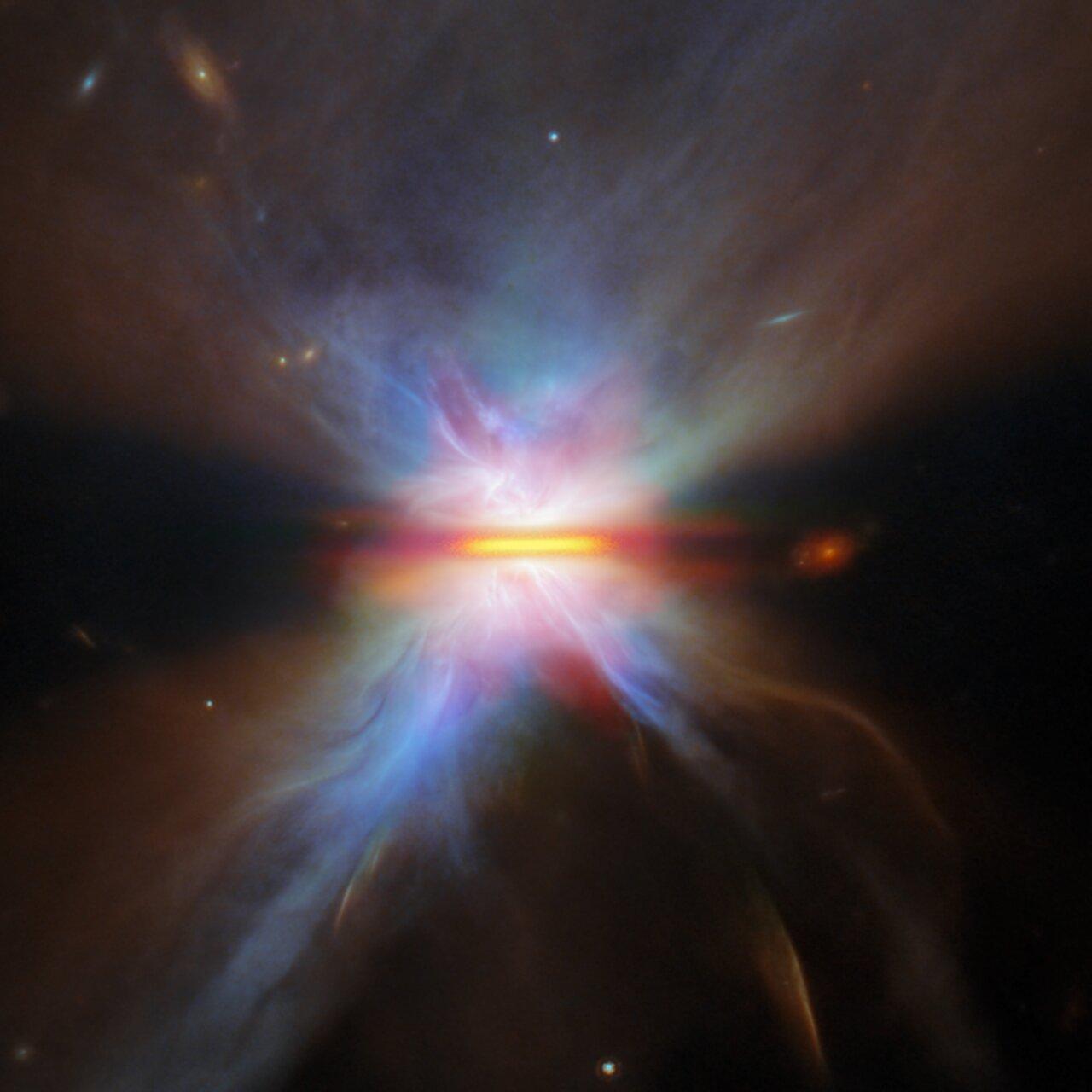
Together, these three powerful facilities paint a fascinating multiwavelength portrait of a planetary birthplace. Webb reveals the distribution of tiny dust grains as well as the reflection of near-infrared light off of dusty material that extends a large distance from the disc. Hubble focuses on the dust lane as well as clumps and streaks surrounding the dust that suggest the star is still collecting mass from its surroundings as well as shooting out jets and outflows. ALMA detects the glow of larger dust grains within the disk, showing that for a disc as young as IRAS 04302, the dust has yet to settle into a narrow plane as is expected for more evolved discs.
The Webb observations of IRAS 04302 were taken as part of the Webb GO programme #2562 (PI F. Ménard, K. Stapelfeldt). This programme investigates four protoplanetary discs that are oriented edge-on from our point of view, aiming to understand how dust evolves within these discs. The growth of dust grains in protoplanetary discs is believed to be an important step toward planet formation.
Links: Wide-field view of IRAS 04302+2247 Science paper (M. Villenave et al.) Pan video
IMAGE CREDIT: ESA/Webb, NASA & CSA, M. Villenave et al. CC BY 4.0