Loading photo
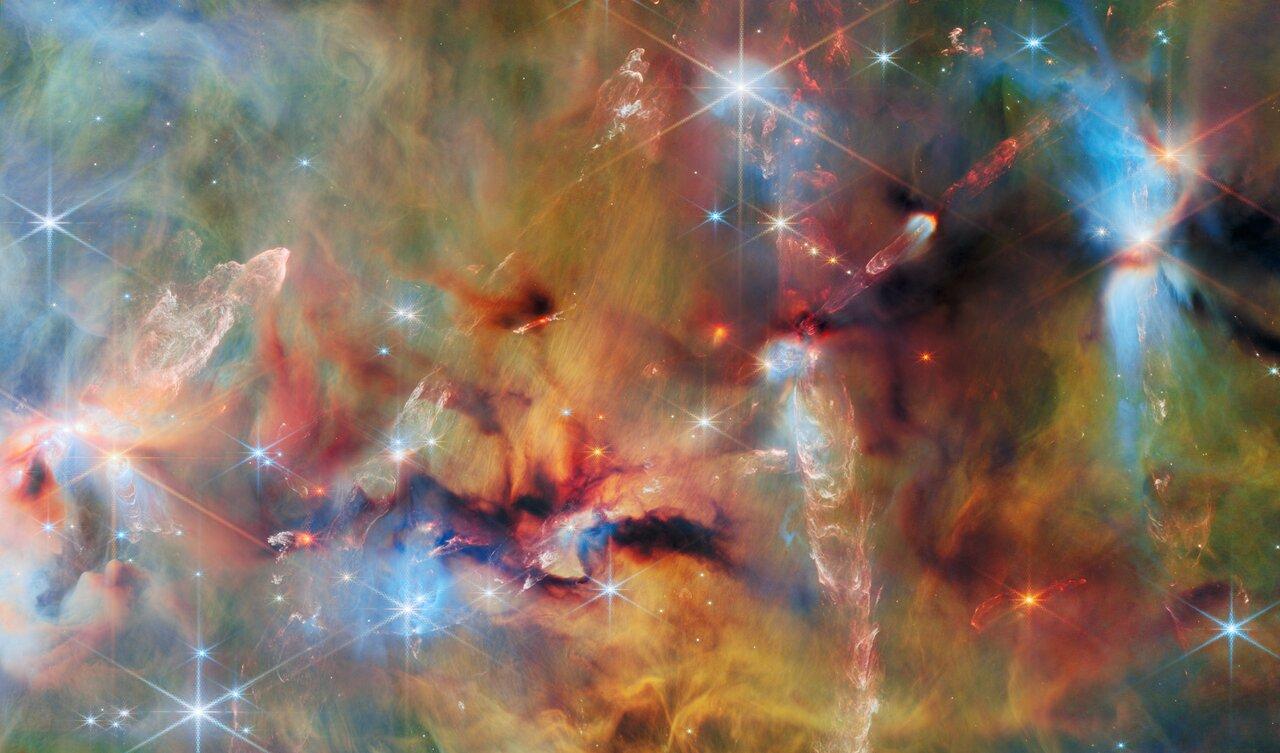
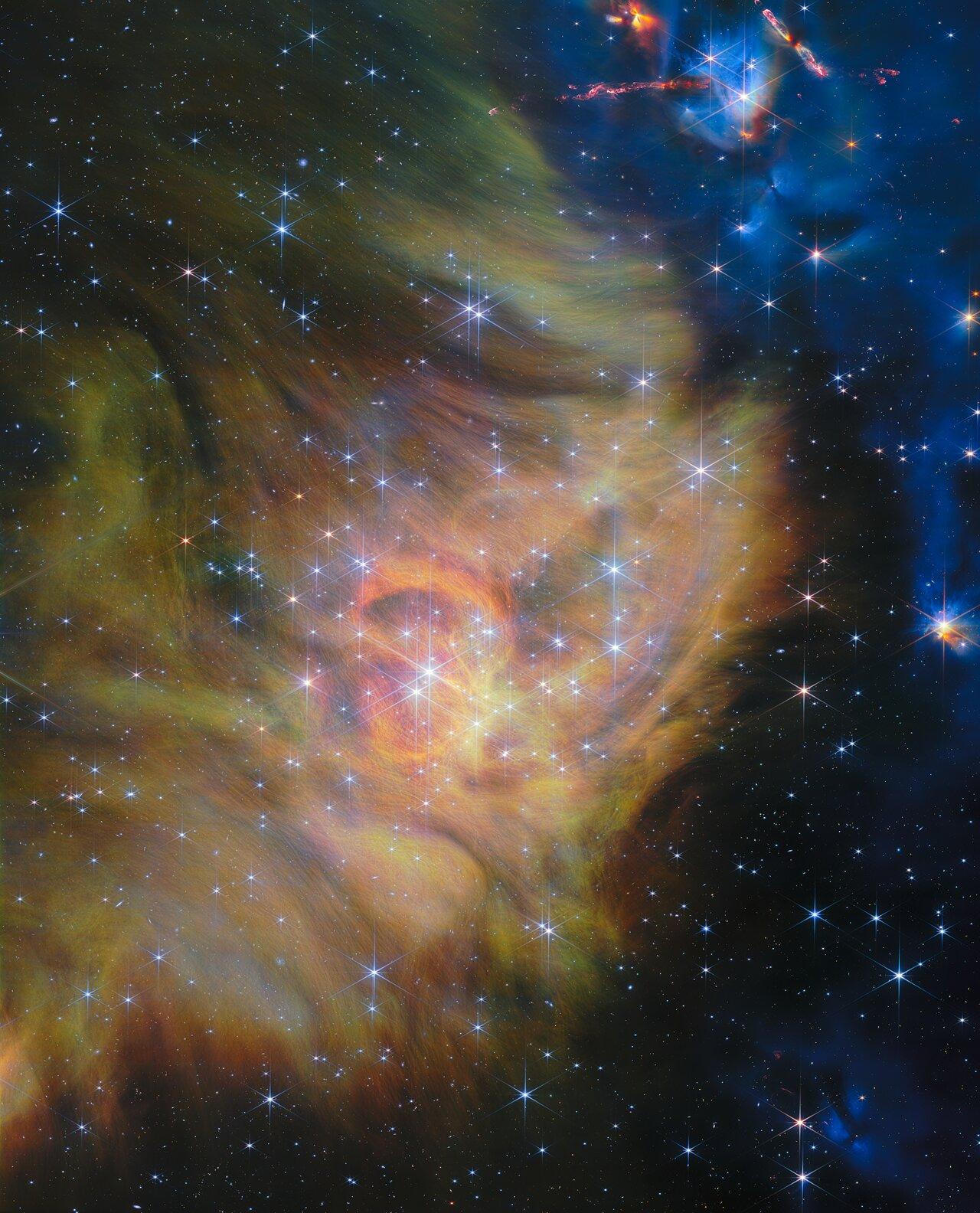
Webb’s Near-Infrared Camera (NIRCam) was used to capture this view of OMC-2. The thick gas and dust in and around the Orion Nebula blocks any light coming from OMC-2 at visible wavelengths, and the clouds in OMC-2 itself obscure the protostars that astronomers really want to find. Only in the infrared do we see these protostars begin to shine out from their cocoons of dust. In many places, the cold dust is so dense that it absorbs all or almost all light, creating dark globules. Orange, brown and some of the red colours mark warmer dust that absorbs some light and emits some of its own. The yellow to green gradient is largely emission from polycyclic aromatic hydrocarbons (PAHs), while light from stars and protostars scattered by dust grains is seen here primarily as blue and cyan hazes. Gas heated by the outflows creates the detailed, glowing red ridges.
The data was collected in observing programme #5804, which aims to study the star formation in OMC-2 and its immediate neighbour, OMC-3. Since these molecular clouds are so near to Earth, they are excellent laboratories to learn about the earliest stages of stellar evolution. Astronomers will use the data from Webb to investigate how the many outflows affect star formation in the two regions, how the ultraviolet emission from the young stars impacts chemistry in the circumstellar discs which one day will form planets, and how gas and dust accretes onto the tens of protostars in the region.
Links
Pan video: OMC-2 Zoom video: OMC-2 Space Sparks episode: OMC-2 Image on ESA website
IMAGE CREDIT: ESA/Webb, NASA & CSA, T. Megeath, M. Zamani (ESA/Webb) Acknowledgement: M. H. Özsaraç. CC BY 4.0