FROM THE WEBB ARCHIVE / 29 Apr 2025
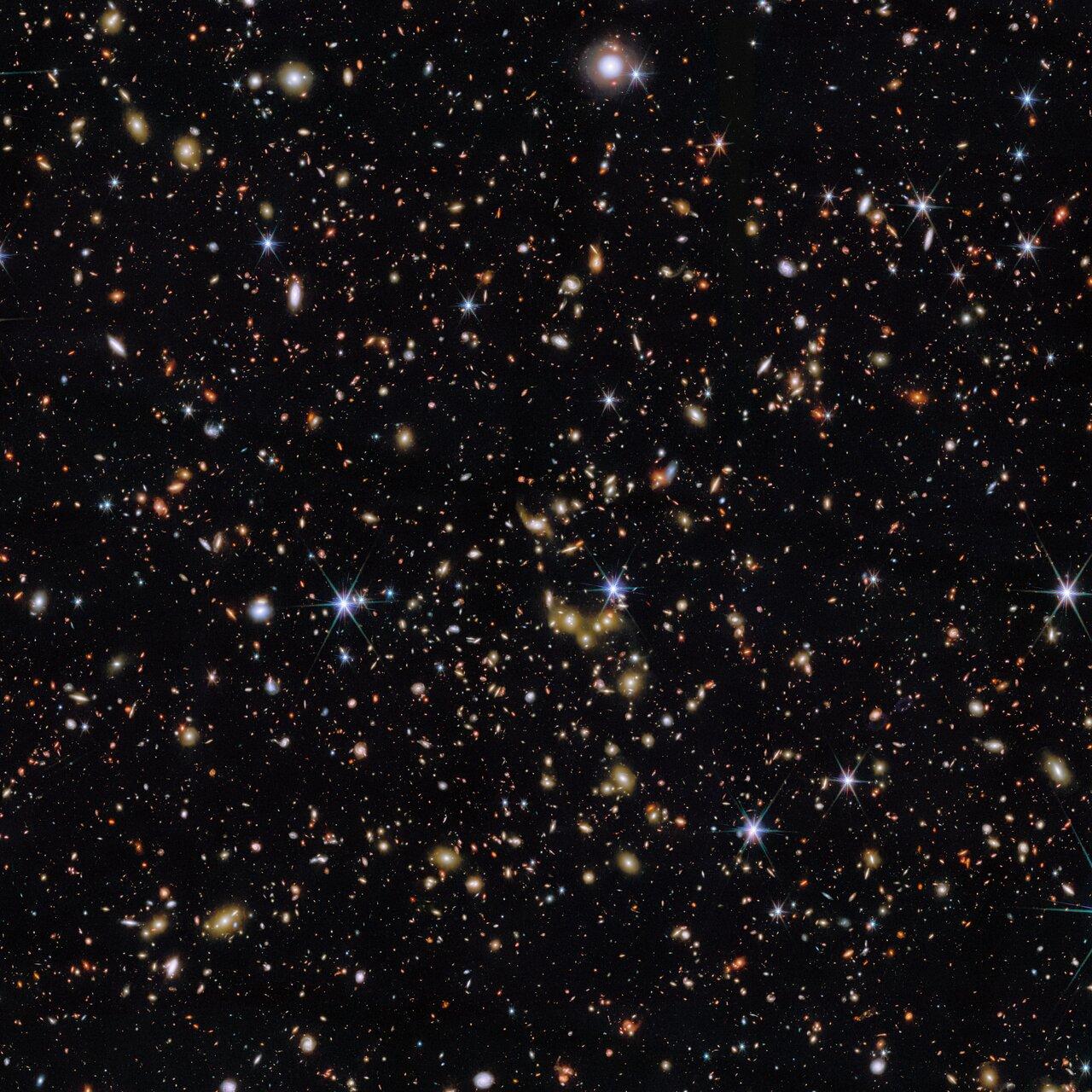
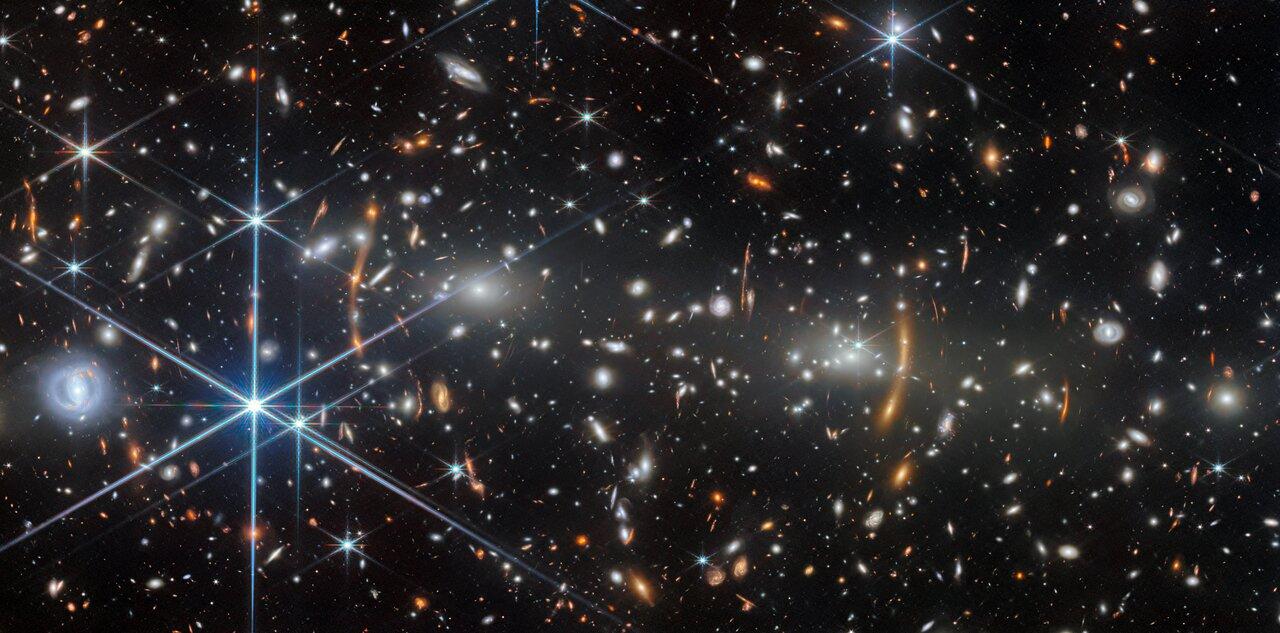
A visual feast of galaxies This new Picture of the Month from the NASA/ESA/CSA James Webb Space Telescope features an astounding number of galaxies. The objects in this frame span an incredible range of distances, from stars within our own Milky Way, marked by diffraction spikes, to galaxies billions of light-years away.
The star of this image is a group of galaxies, the largest concentration of which can be found just below the centre of this image. These galaxies glow with white-gold light. We see this galaxy group as it appeared when the Universe was 6.5 billion years old, a little less than half the Universe’s current age.
More than half of the galaxies in our Universe belong to galaxy groups like the one pictured here. Studying galaxy groups is critical for understanding how individual galaxies link up to form galaxy clusters, the largest gravitationally bound structures in the Universe. Belonging to a galaxy group can also alter the course of a galaxy’s evolution through mergers and gravitational interactions.
The galaxy group pictured here is the most massive group in what’s called the COSMOS-Web field. COSMOS stands for Cosmic Evolution Survey. This survey has enlisted several telescopes, including Webb, the NASA/ESA Hubble Space Telescope, and ESA’s XMM-Newton space observatory to gaze deeply at a single patch of sky. The COSMOS-Web galaxy group team, led by Dr. Gozaliasl, has presented largest sample of galaxy groups detected by Webb thus far using the Amico algorithm.
COSMOS-Web aims to understand how massive structures like galaxy clusters came to be. Webb’s infrared capabilities and sensitive instruments have pushed the search for galaxy groups farther back into cosmic history, revealing galaxy groups as far back as when the Universe was only 1.9 billion years old — just 14% of its current age.
This image combines data from Webb’s Near-InfraRed Camera (NIRCam) with observations from the Hubble Space Telescope to present a visual feast of galaxies. Take a moment to zoom in and examine this galactic buffet: you’ll see galaxies with delicate spiral arms or warped disks, galaxies with smooth, featureless faces, and even galaxies that are interacting or merging and have taken on an array of strange shapes.
The range of colours is also fascinating, representing both galaxies with different ages of stars — younger stars appear bluer, and older stars appear redder — as well as galaxies at different distances. The more distant a galaxy, the redder it appears.
COSMOS-Web is a 255-hour Webb Treasury programme that maps 0.54 square degrees (a little more than two-and-a-half times the area covered by three full moons) of the COSMOS field using four NIRCam filters. Treasury programmes have the potential to answer multiple important questions about our Universe.