Striking star clusters and irregular clumps · Beyond Orbit
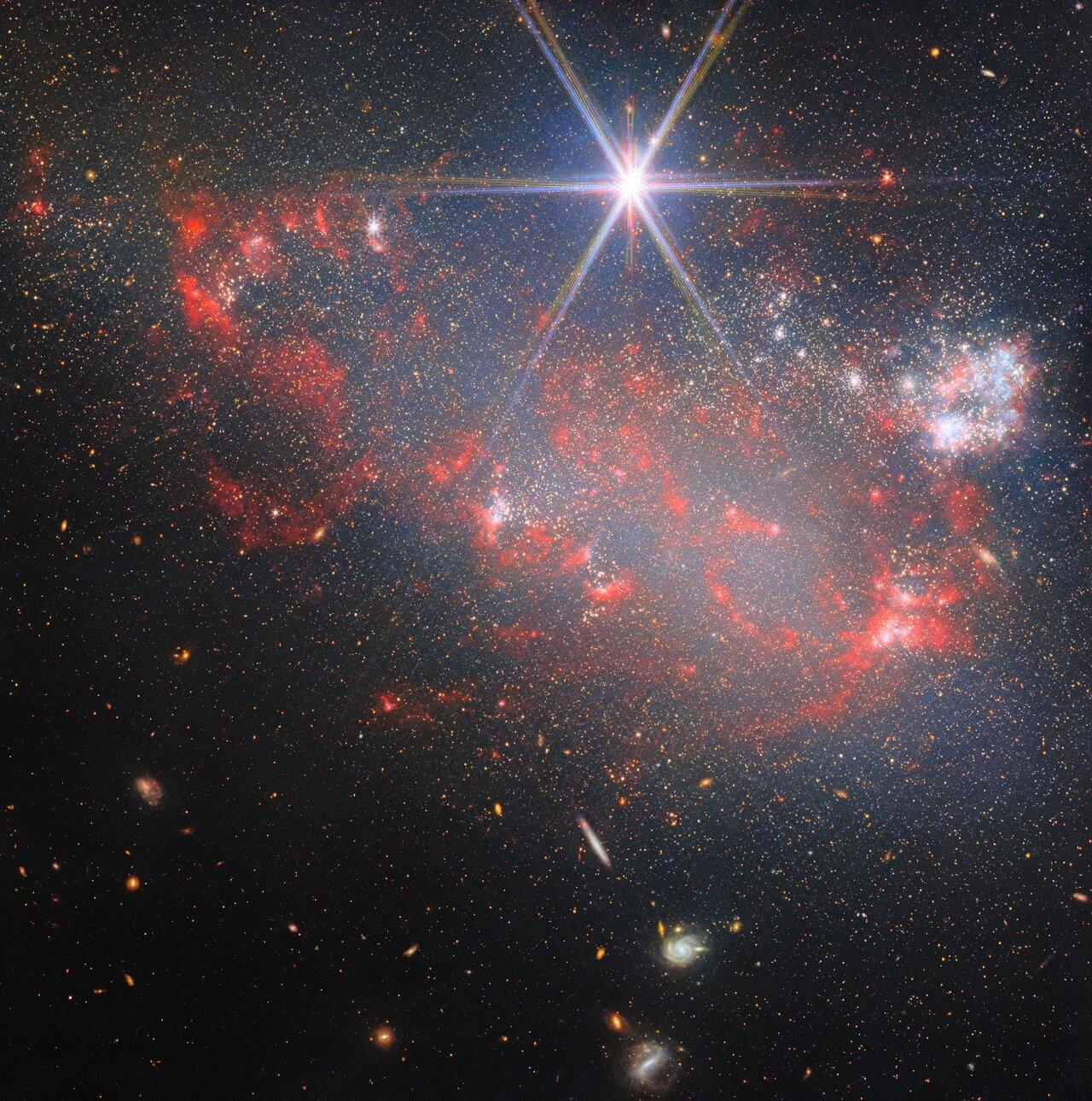
The brightest of the bright spots in Arp 263 is a shining star, named BD+17 2217. It appears so large and bright, with long diffraction spikes created by the telescope’s optics, because it is part of our own galaxy. The galaxies that appear in the background are much more distant, most hundreds of millions of light-years away from both us and Arp 263. A few of these galaxies are identifiable as spiral galaxies, but Webb’s NIRCam reveals the hundreds of much more distant galaxies lurking in the background as orange dots.
This image was made with data from observing programme #3707 (PI: Leroy), a survey of the nearby, large, star-forming galaxies in the southern sky. These galaxies are close enough that Webb’s sharp vision can deliver a detailed picture of the stars, star clusters and interstellar dust within the galaxy. The observations will be used to better understand the cycle of star formation and how it plays out across galaxies; Arp 263, with its disturbed disc of gas and its chaotic star formation, presents a unique and fascinating target for these investigations.
Links Slider tool Pan video: Arp 263 Transition video: Hubble and Webb's views of Arp 263
IMAGE CREDIT: ESA/Webb, NASA & CSA, A. Leroy. CC BY 4.0