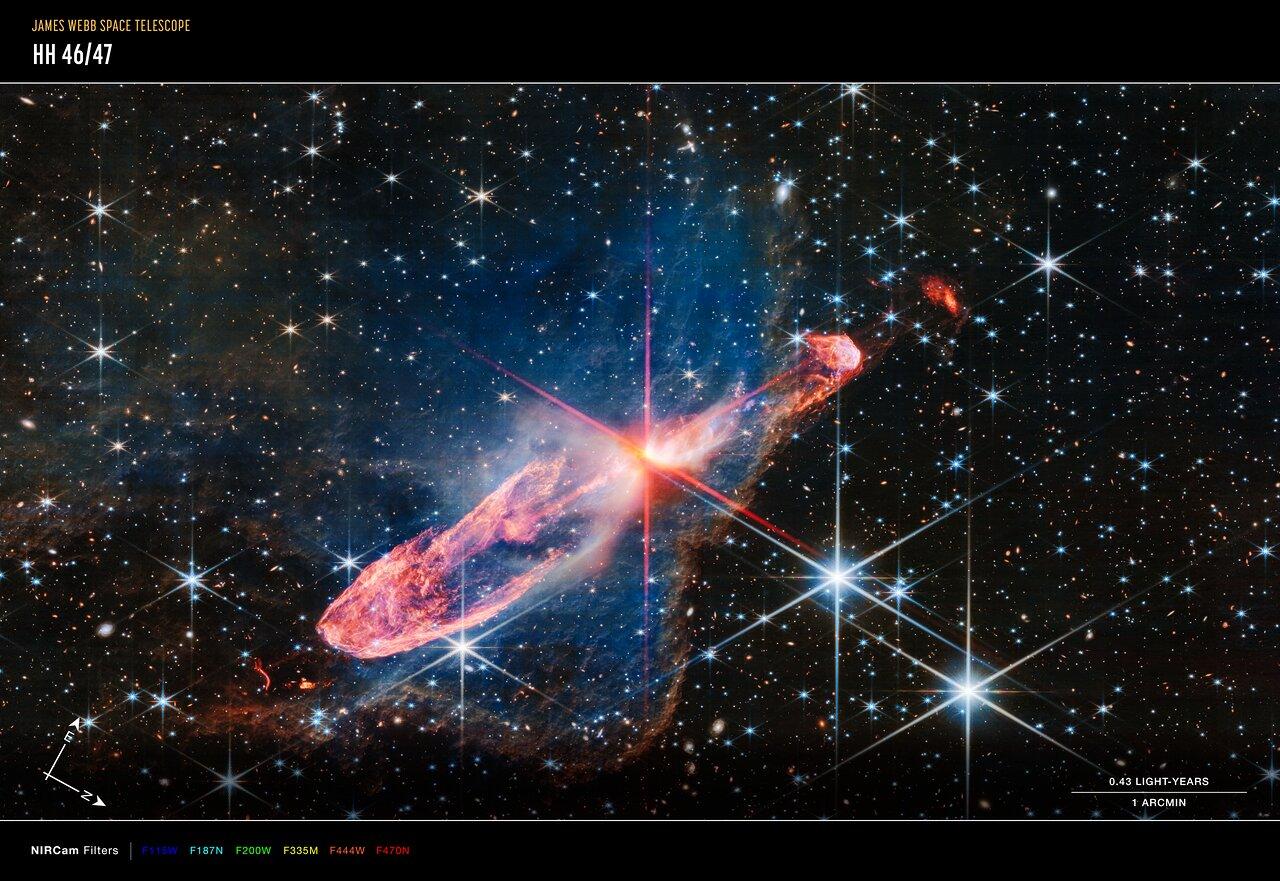
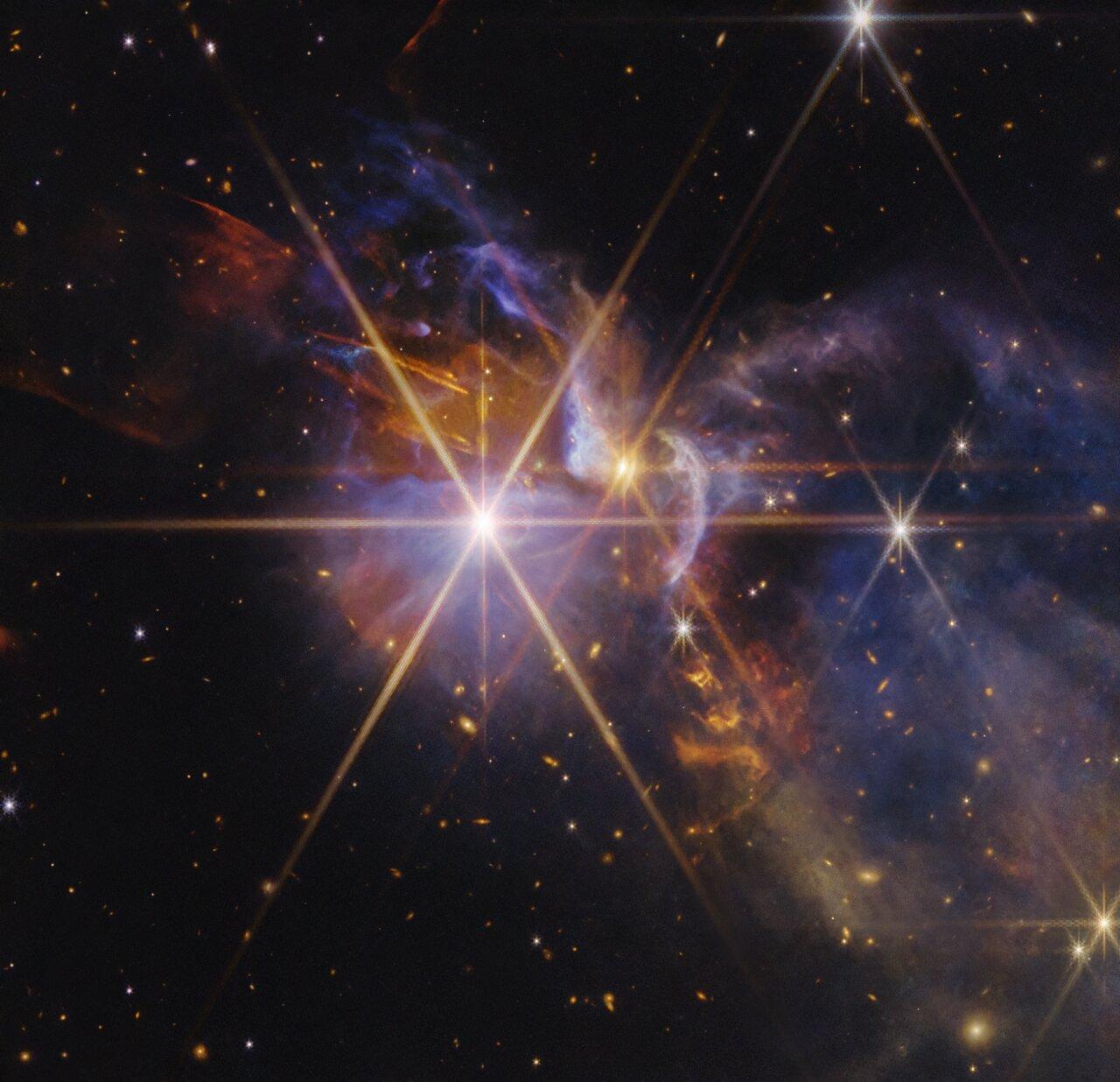
The blue nebula influences the shapes of the orange jets shot out by the central stars. As ejected material rams into the nebula on the lower left, it takes on wider shapes, because there is more opportunity for the jets to interact with molecules within the nebula. Its material also causes the stars’ ejections to light up.
Over millions of years, the stars in Herbig-Haro 46/47 will form fully — clearing the scene.
Take a moment to linger on the background. A profusion of extremely distant galaxies dot Webb’s view. Its composite NIRCam (Near-Infrared Camera) image is made up of several exposures, highlighting distant galaxies and stars. Blue objects with diffraction spikes are stars, and the closer they are, the larger they appear. White-and-pink spiral galaxies sometimes appear larger than these stars, but are significantly farther away. The tiniest red dots, Webb’s infrared specialty, are often the oldest, most distant galaxies.
TELESCOPE / INSTRUMENT
NIRCam image - annotated
IMAGE CREDIT: NASA, ESA, CSA, J. DePasquale (STScI). CC BY 4.0