FROM THE WEBB ARCHIVE / 9 Aug 2023
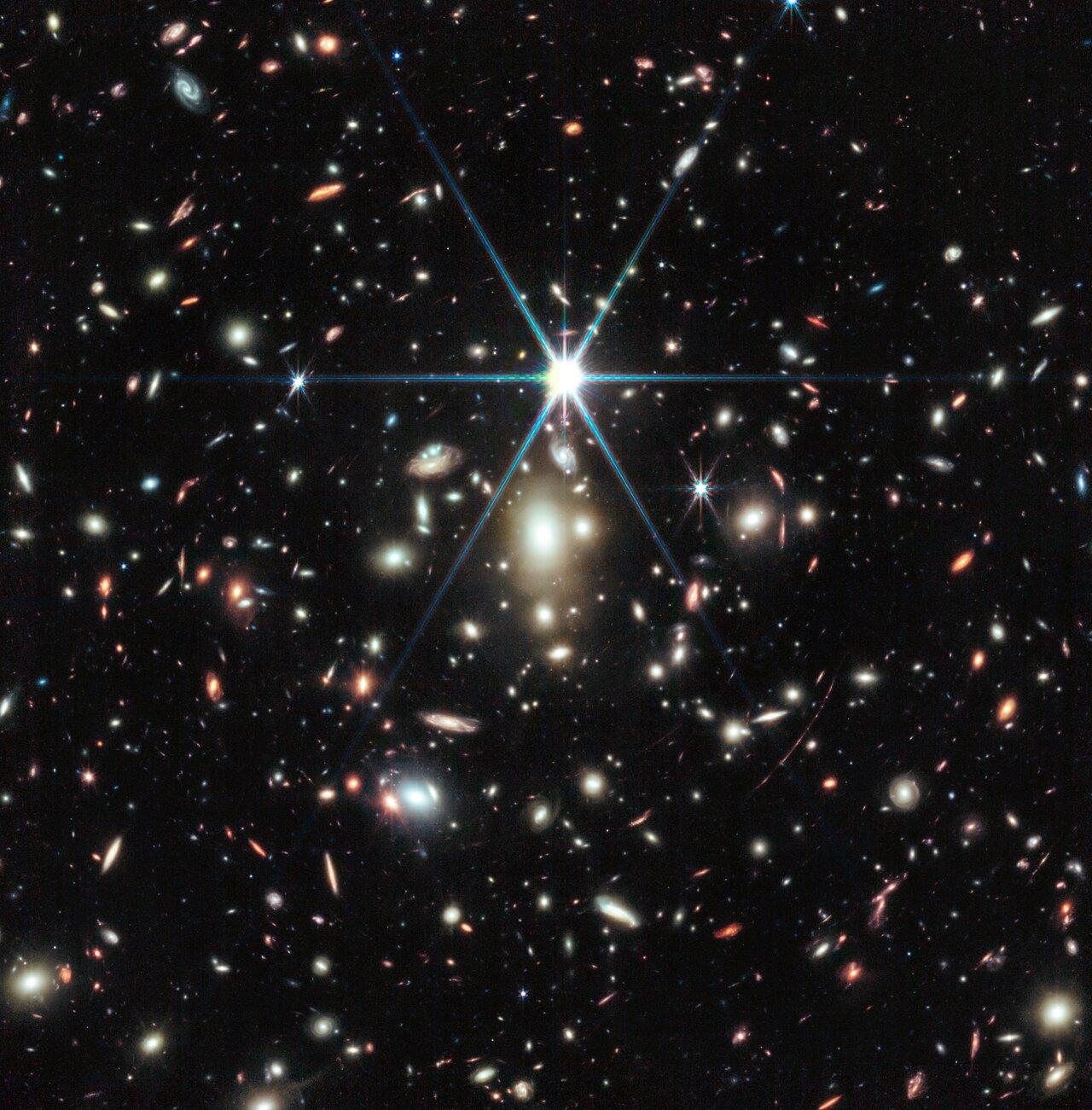
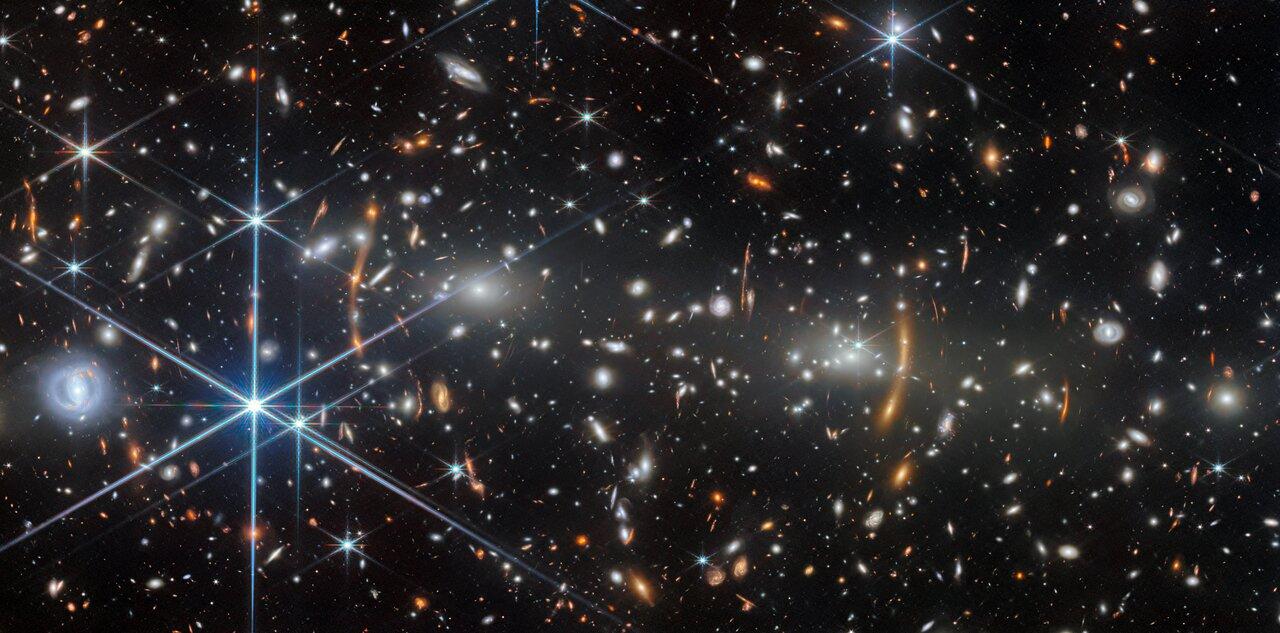
Galaxy cluster WHL0137-08 This image from the NASA/ESA/CSA James Webb Space Telescope of a massive galaxy cluster called WHL0137-08 contains the most strongly magnified galaxy known in the Universe’s first billion years: the Sunrise Arc, and within that galaxy, the most distant star ever detected.
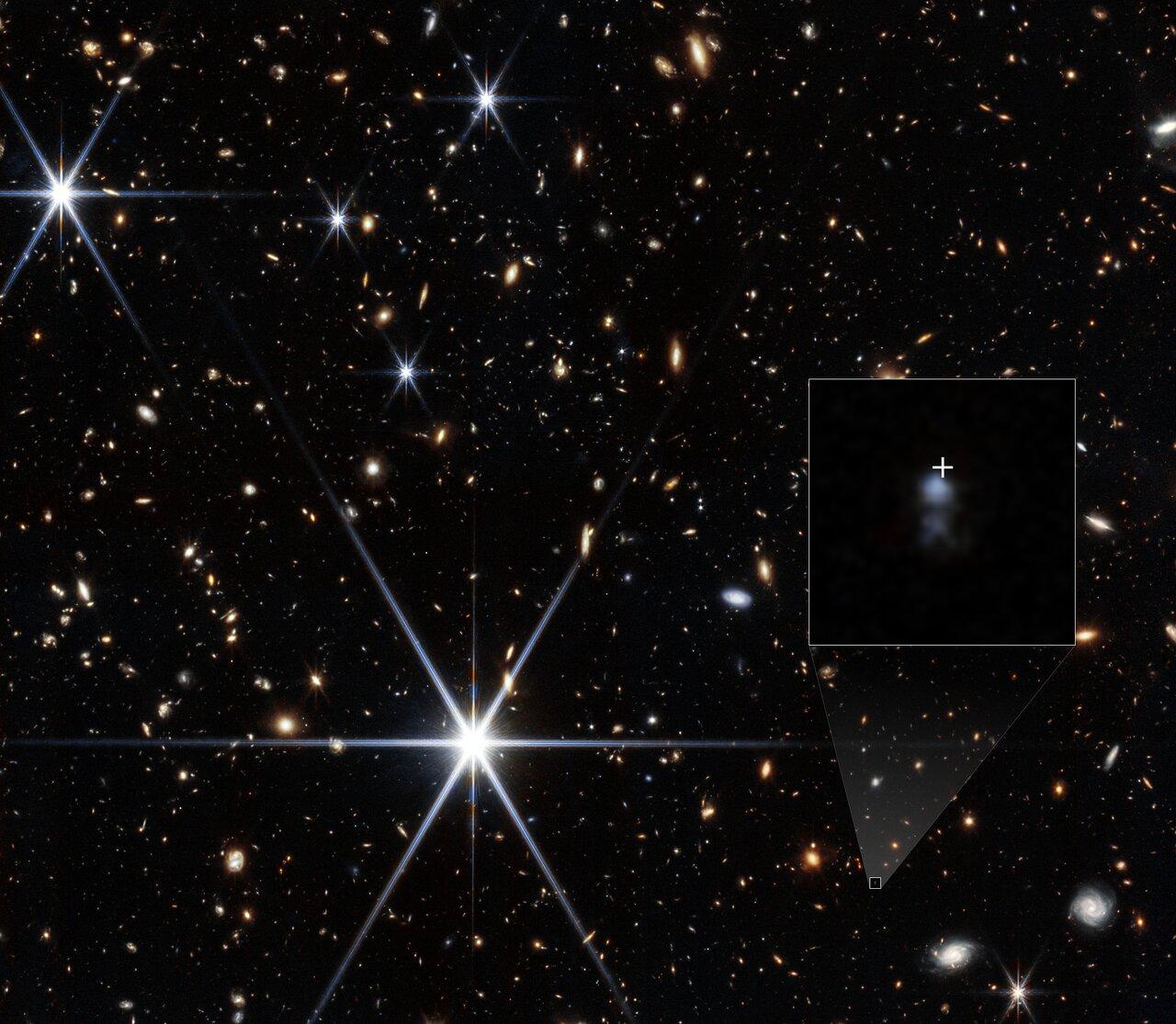
The star, nicknamed Earendel, was first discovered by the NASA/ESA Hubble Space Telescope. Follow-up observations using Webb’s NIRCam (Near-Infrared Camera) reveals the star to be a massive B-type star more than twice as hot as our Sun, and about a million times more luminous.
Earendel is positioned along a ripple in spacetime that gives it extreme magnification, allowing it to emerge into view from its host galaxy, which appears as a red smear across the sky. The star is detectable only due to the combined power of human technology and nature via an effect called gravitational lensing.
While other features in the galaxy appear multiple times due to the gravitational lensing, Earendel only appears as a single point of light even in Webb’s high-resolution infrared imaging. Based on this, astronomers determine the star is magnified by a factor of at least 4000, and thus Earendel is extremely small – the most distant stellar source ever detected. The previous record-holder for the most distant star was detected by Hubble around 4 billion years after the Big Bang.
In this image, the Sunrise Arc appears just below the diffraction spike at the 5 o’clock position. The fuzzier, white galaxies at the centre of the image are part of the galaxy cluster bound together by gravity. The various redder, curved galaxies are background galaxies picked up by Webb’s sensitive mirror.
Webb’s NIRCam also shows other remarkable details in the Sunrise Arc. Features include both young star-forming regions and older established star clusters. On either side of the wrinkle of maximum magnification, which runs right through Earendel, these features are mirrored by the distortion of the gravitational lens. The region forming stars appears elongated, and is estimated to be less than 5 million years old. Smaller dots on either side of Earendel are two images of one older, more established star cluster, estimated to be 10 million years or older. Astronomers determined this star cluster is gravitationally bound and likely to persist until the present day. This shows us how the globular clusters in our own Milky Way might have looked when they formed 13 billion years ago.
Astronomers are currently analysing data from Webb’s NIRSpec (Near-Infrared Spectrograph) instrument observations of the Sunrise Arc galaxy and Earendel, which will provide precise composition and distance measurements for the galaxy.