Mars Is Mighty in First Webb Observations of Red Planet · Beyond Orbit
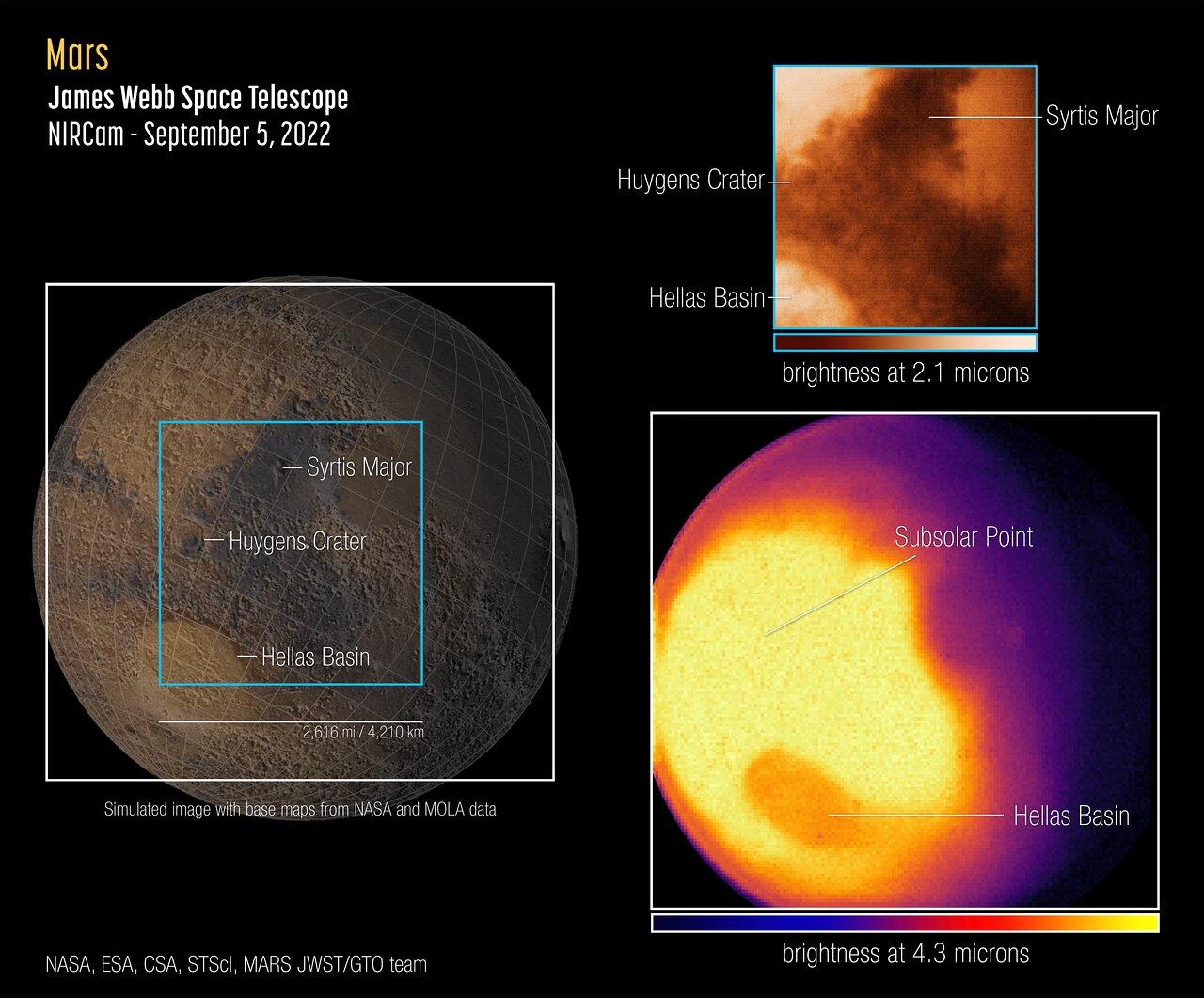
However, temperature is not the only factor affecting the amount of 4.3-micron light reaching Webb with this filter. As light emitted by the planet passes through Mars’ atmosphere, some gets absorbed by carbon dioxide (CO2) molecules. The Hellas Basin – which is the largest well-preserved impact structure on Mars, spanning more than 2,000 kilometres – appears darker than the surroundings because of this effect.
In the future, Webb will be using this imaging and spectroscopic data to explore regional differences across the planet, and to search for trace species in the atmosphere, including methane and hydrogen chloride.
These observations of Mars were conducted as part of Webb’s Cycle 1 Guaranteed Time Observation (GTO) Solar System program led by Heidi Hammel of AURA.
ESA operates two Mars orbiters, Mars Express and the ExoMars Trace Gas Orbiter, that have brought a treasury of insight into the Red Planet’s atmosphere and surface. Furthermore, ESA collaborates with the Japanese Aerospace Exploration Agency (JAXA) on the Martian Moons eXploration (MMX) mission, soon to launch for Mars’ moon Phobos.
Note: This post highlights images from Webb science in progress, which has not yet been through the peer-review process.
IMAGE CREDIT: NASA, ESA, CSA, STScI, Mars JWST/GTO team. CC BY 4.0